
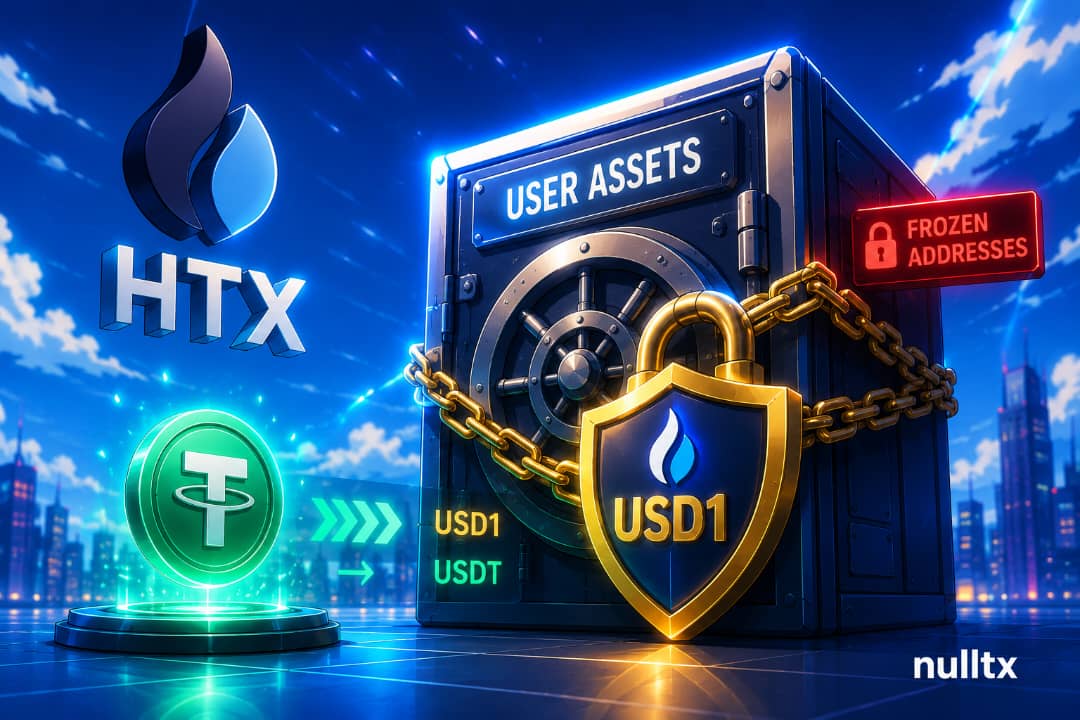
One of the crypto industry’s largest exchanges HTX is now in an open standoff with World Liberty Financial.
The Donald Trump family-backed crypto project, after WLFI unilaterally froze HTX-related on-chain addresses without warning.
Thereby, triggering an emergency response that has left thousands of users locked out of their assets and raising uncomfortable questions about who truly owns digital assets in 2026.
Contents
HTX Pulls The Trigger On Emergency Protective Measures
HTX moved fast. The exchange formally announced the suspension of all WLFI-related trading services, covering the WLFI/USDT, USD1/USDT, BTC/USD1, and ETH/USD1 trading pairs, effective 13:00 UTC on June 5, 2026.
Alongside the trading halt, HTX suspended USD1 deposits and withdrawals entirely and took the additional step of forcibly converting all USD1 holdings on the platform into USDT, crediting the equivalent funds directly into affected users’ accounts.
The exchange was blunt about why. WLFI, the project behind both the WLFI governance token and the USD1 stablecoin, had frozen HTX-associated on-chain addresses citing an ongoing UK sanctions compliance review, and did so without prior notice, without providing a clear legal basis, and without explaining the scope or resolution process of the action. HTX says it still has not received a satisfactory explanation.
WLFI Cited UK Sanctions Screening But The Affected Assets Belong To Users
This is where the situation gets particularly contentious. HTX is not disputing that sanctions compliance reviews exist or that exchanges must take them seriously. What it is disputing is the target of the freeze and the process used to execute it.
Something deeply concerning happened recently.
The WLFI team froze WLFI tokens held in HTX-related addresses, citing the ongoing UK sanctions review.
To be clear:
These are not assets belonging to any sanctioned entity.
They are not HTX’s assets.
They are assets legally… https://t.co/duQg1xDBSy pic.twitter.com/UI8hJYnN48
— 火币HTX六爷|火币赚币 (@HTX_Molly) June 6, 2026
HTX representatives made clear that the frozen addresses do not belong to any sanctioned entity. They are not HTX’s own treasury addresses. They are addresses holding assets legally purchased and owned by individual platform users, retail investors who had nothing to do with whatever triggered the sanctions screening in the first place.
In its official statement, HTX put it plainly: “These are not assets belonging to any sanctioned entity. They are not HTX’s assets. They are assets legally purchased and owned by individual users.” The exchange has formally demanded that WLFI lift the freeze immediately and restore user access without further delay.
A Stablecoin Issuer Freezing Its Own Holders
What makes this episode cut deeper than a routine compliance dispute is the identity of the project doing the freezing. USD1 is WLFI’s own stablecoin. WLFI’s own token holders are the ones sitting with restricted assets. The project froze the addresses of the very community it is supposed to be serving.
HTX did not let that irony pass without comment. The exchange pointed out that while other platforms across the industry have been actively cooperating to help affected users and lift unnecessary restrictions, WLFI chose the opposite, locking out its own holders and supporters without due process or transparency. That is a damaging optic for any project, and especially damaging for one carrying the political weight and public profile that comes with Trump family backing.
The Question No One In Crypto Wants To Answer
HTX is using this moment to surface a question that has been simmering beneath the surface of the crypto industry for years: do users actually own their digital assets, or can a project unilaterally revoke access at any time it chooses?
The exchange framed it directly in its statement: “User ownership is one of the core principles of blockchain. No project should be able to arbitrarily restrict lawful user assets without transparent procedures and clear justification.” It is a principle most people in the space would agree with in theory. The WLFI situation tests whether it holds in practice.
The freeze, as HTX describes it, came with no warning, no explanation of the legal standard being applied, no defined scope, and no clear path to resolution. That is not a compliance process, that is unilateral asset control. And if a project can do it once, to thousands of users, without consequence, then the on-chain ownership guarantee that underpins the entire value proposition of crypto becomes a great deal shakier.
User Funds Remain On-Chain And Are Not Lost
HTX has been careful to reassure its community that no funds have disappeared. The WLFI tokens remain on-chain, they are frozen, not gone. Withdrawals will resume as soon as the freeze is lifted. The USD1 holdings have already been converted to USDT and returned to user accounts as a precautionary buffer against any further instability linked to the stablecoin while the dispute is unresolved.
The exchange closed its statement with language that signals this is far from over: “Today, WLFI holders are affected. Tomorrow, it could be anyone. User assets are not negotiable. We will continue to take every available step to protect our users.” HTX says it will keep the community updated as the situation develops.
The ball is now in WLFI’s court. Whether the Trump-backed project responds with transparency or digs in will likely define how this story ends, and how the broader crypto community judges its commitment to the principles it claims to represent.
Disclosure: This is not trading or investment advice. Always do your research before buying any cryptocurrency or investing in any services.
Follow us on Twitter @nulltxnews to stay updated with the latest Crypto, NFT, AI, Cybersecurity, Distributed Computing, and Metaverse news!