

In just 48 hours, a single wallet dismantled the SIREN token market, dumped 670 million tokens representing roughly 92% of the entire circulating supply, and walked away with tens of millions of dollars in stablecoins.
What happened to SIREN is not a cautionary tale about volatility, it is a textbook case of what a coordinated, large-scale supply dump looks like in real time, and what it leaves behind.
Contents
A Single Whale Controlled 92% of SIREN Total Supply
The starting point here is the concentration of supply, and it is staggering.
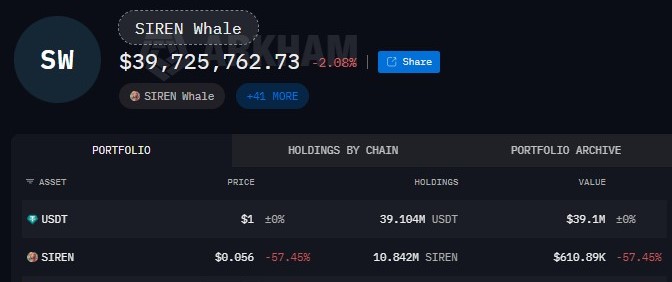 Before the sell-off began, one whale wallet held approximately 670 million SIREN tokens, a figure that represents around 92% of the token’s total supply.
The $SIREN whale has sold 670M $SIREN (92% of the total supply) in just 2 days, causing the price to crash by over 90%!
By selling $SIREN, the whale has received 64.8M $USDT.
Of that, 25.7M $USDT has been deposited to exchanges, while 39.1M $USDT remains on-chain.… pic.twitter.com/LV3UrMExYV
— Lookonchain (@lookonchain) June 15, 2026
That is not a large holder. That is effective control of the entire asset. Any token where a single entity commands nine out of every ten tokens in existence is operating on borrowed time, and SIREN’s market found that out the hard way.
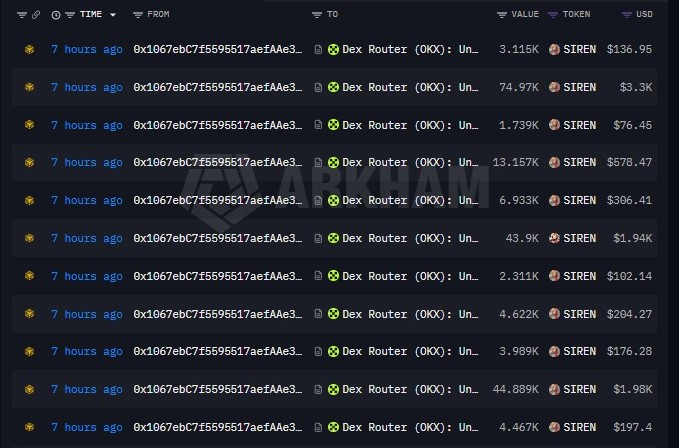
The sell-off unfolded over two days. The wallet moved 670 million SIREN into the market in what analysts are describing as relentless selling pressure, and the market simply had no capacity to absorb it. When supply of that magnitude hits an open order book, price discovery collapses. That is exactly what happened here.
SIREN Price Crashes More Than 90%
The price impact was immediate and devastating. SIREN crashed more than 90% as the whale’s selling continued without pause across the two-day window. One moment holders were watching what appeared to be normal market fluctuations. By the time the dust settled, the token had lost nearly all of its value, and the entity responsible had already converted the bulk of those tokens into hard stablecoins.
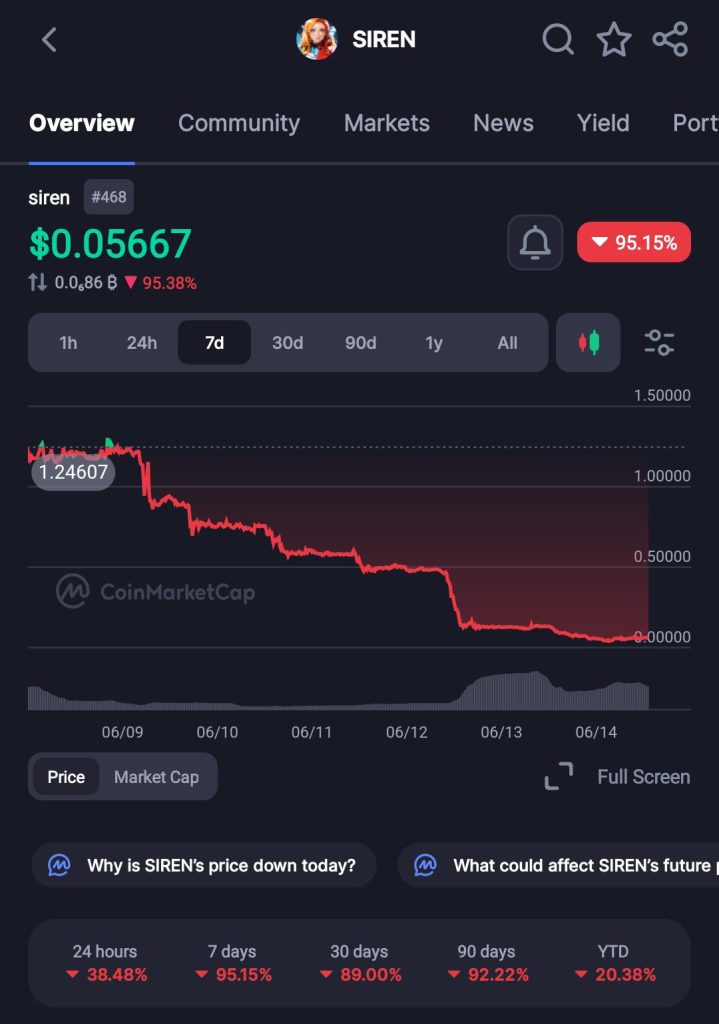
This was not a slow distribution designed to minimize impact. There was no attempt to manage the sell-off in a way that preserved price. It was, in the most literal sense, an avalanche, a single concentrated burst of supply that overwhelmed every buyer in the market and left the chart looking exactly the way you would expect after 670 million tokens hit the open market within 48 hours.
The Whale Secured $64.8 Million USDT from the Token Sale
By unloading the entire position, [the whale collected approximately $64.8 million USDT in total proceeds from the sell-off. That figure alone tells you how much value was sitting inside that concentrated position before the dump began, and it makes clear that whoever controlled this wallet came away from the operation with a substantial profit, regardless of what the collapse did to every other participant in the SIREN market.
The money did not all move in the same direction. Of the $64.8 million collected, around $25.7 million USDT has already been deposited to centralized exchanges, while the remaining $39.1 million USDT is still sitting on-chain. That distinction matters. The on-chain balance represents what analysts are calling significant dry powder, funds that have not yet been deployed or withdrawn, sitting in wallets that are still being watched closely by on-chain trackers.
Wallet Fragmented Remaining Holdings Across Hundreds of Addresses to Evade Tracking
What happened after the sell-off is arguably as interesting as the dump itself. After moving through the bulk of the SIREN position, the controller began fragmenting remaining holdings across hundreds of on-chain addresses, a deliberate obfuscation pattern that analysts recognize as a method for evading tracking tools and making it harder to follow the money trail.
The SIREN Whale Just Nuked the Entire Chart 😳. This has to be one of the most brutal whale exits we've seen in a while.
In just 48 hours, the SIREN whale dumped a staggering 670 million $SIREN , roughly 92% of the token's total supply.
The result is a complete collapse.… pic.twitter.com/jf1RINZBTW
— EyeOnChain (@EyeOnChain) June 15, 2026
Approximately 200 million SIREN also flowed into centralized exchange wallets across Binance, Gate, and KuCoin during this period. The fragmentation pattern, combined with the exchange deposits, suggests the same entity is recycling positions rather than fully exiting, a detail that on-chain investigators are tracking carefully. The controller still holds roughly $39.1 million USDT on-chain, meaning the operation is not fully concluded.
What The SIREN Collapse Reflects
The final tally from the SIREN incident makes for grim reading for anyone who held the token. 670 million tokens sold, 92% of total supply liquidated, $64.8 million USDT extracted, $25.7 million moved to exchanges, $39.1 million still on-chain, and a price decline of more than 90%, all within a two-day window.
The SIREN situation is not unique in crypto, but each time it happens it reinforces the same lesson. Token supply concentration is not just a metric on a data dashboard, it is a loaded gun pointed at every other participant in the market. When 92% of a token’s supply sits in a single wallet, the question is never whether it will be sold. The question is only when, and how fast. In SIREN’s case, the answer was fast enough to make the chart nearly unreadable and the losses nearly total for anyone caught on the wrong side of a whale that had already made up its mind.
Disclosure: This is not trading or investment advice. Always do your research before buying any cryptocurrency or investing in any services.
Follow us on Twitter @nulltxnews to stay updated with the latest Crypto, NFT, AI, Cybersecurity, Distributed Computing, and Metaverse news!