

Thirty-two Bitcoin, Roughly $2.5 million at current prices, for a company sitting on 843,706 BTC worth over $60 billion, that is barely a rounding error on the balance sheet.
But the significance of what Strategy just did has almost nothing to do with the size of the sale and everything to do with what it signals, because for years, Michael Saylor’s company has built its entire public identity around a single, unambiguous position: we do not sell Bitcoin. Last week, they did.
Contents
The First Confirmed Sale in Years
Strategy sold 32 BTC last week at approximately $77,135 per coin, generating roughly $2.47 million in proceeds, the first confirmed Bitcoin sale the company has made in years. The move accompanies a separate capital raise of $128.3 million through share issuance, confirming that the treasury is being actively managed rather than simply held in place.
Michael Saylor's @Strategy sold 32 $BTC($2.47M) at $77,135 last week.
This is #Strategy's first $BTC sale in over 3 years.
The last time #Strategy sold $BTC was on Dec. 22, 2022, when they sold 704 $BTC at $16,776.
But they quickly bought back 810 $BTC at $16,845 on Dec. 24,… pic.twitter.com/WruOB9HufD
— Lookonchain (@lookonchain) June 1, 2026
The last time Strategy sold Bitcoin was December 22, 2022, when the company moved 704 BTC at $16,776.
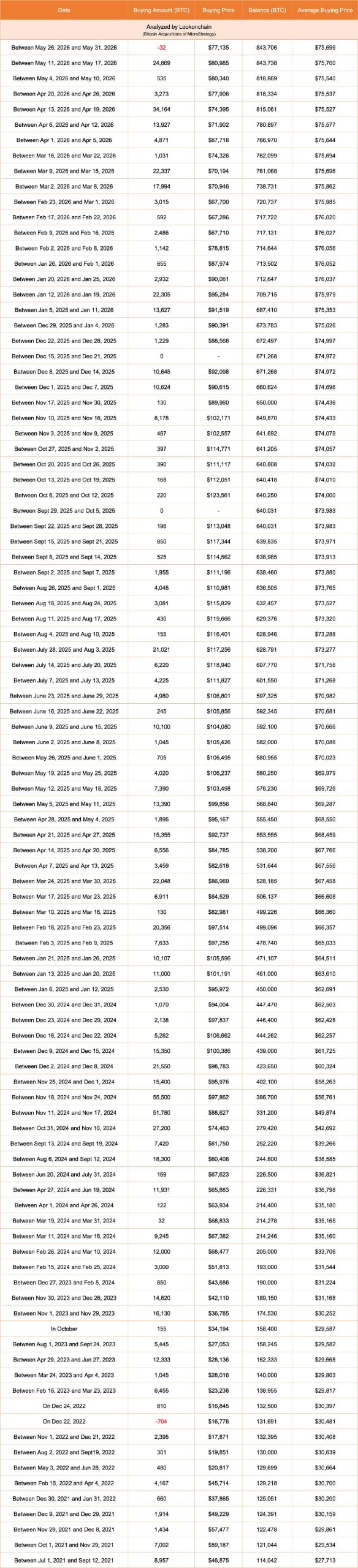 That sale was followed almost immediately by a buyback of 810 BTC at $16,845 on Christmas Eve of the same year, a move widely interpreted at the time as a tax-loss harvesting maneuver rather than a genuine change in conviction. The current sale does not come with an immediate buyback announcement, and the context surrounding it is meaningfully different.
What Strategy Actually Holds and Why It Still Matters
To understand the sale in proper proportion, the full picture of Strategy’s Bitcoin position is worth laying out clearly. The company currently holds 843,706 BTC at an average purchase price of $75,699 , a position valued at approximately $60.9 billion at current market prices. Against that average cost basis, the company is sitting on an unrealized loss of roughly $2.932 billion, a negative 4.6% return on the aggregate position.
The company maintains a $900 million USD cash reserve and reports $26.1 billion in remaining capacity under its stock issuance program. Preferred dividend payments have also been confirmed, which is where the treasury management framing for the Bitcoin sale becomes relevant. Selling a small parcel of BTC to help fund dividend obligations and optimize the balance sheet is operationally logical, even if the optics of doing it after years of “never sell” rhetoric require careful handling.
The company’s position is that none of this changes the core strategy or the long-term goal. The vast majority of the Bitcoin holdings remain intact, and the stated commitment to accumulation as a primary treasury strategy has not been formally reversed. Thirty-two coins out of 843,706 is 0.0038% of the total position. Mathematically, it is immaterial.
Why The Market Is Reading It Differently
Mathematics and market psychology operate on different timescales and through different lenses. Observers tracking treasury company activity note that the sale has introduced a new expectation into the market, not that Strategy is abandoning Bitcoin, but that the “never sell” commitment is now conditional rather than absolute.
 Once a company that has built its brand on holding at all costs sells even a single coin, the question that follows is not “why did they sell 32?” but “under what conditions will they sell more?”
That shift in framing matters for how Strategy’s stock is priced, for how the company’s Bitcoin treasury is modeled by institutional investors, and for how the broader narrative around corporate Bitcoin accumulation holds together. Strategy’s influence on that narrative has been enormous. It inspired a wave of treasury companies to adopt similar strategies, and its public commitment to never selling has functioned as a kind of credibility anchor for the entire corporate Bitcoin accumulation movement. Removing that anchor, even partially, even over just 32 coins, changes the calculation for everyone watching.
BitMNR Holds The Line But Sits on a 43% Loss
With Strategy now confirmed as having sold, the landscape of treasury companies that have never sold a single coin has narrowed to essentially one significant player: BitMNR.
随着 @Strategy 首次出售 32 枚 BTC、打破了他们之前永不出售 BTC 的态度,市场更为艰难了 (预期他们会继续进行 BTC 出售)。
现在还在增持且还没卖过币的财库公司,就只剩 @BitMNR 了,而他们的持仓已经巨亏 43% ,还能撑到哪一天呢?
所以 Tom Lee @fundstrat ,你准备啥时候卖 ETH ?🥹… pic.twitter.com/Ggx8Sd8T5B— 余烬 (@EmberCN) June 1, 2026
The Ethereum treasury company continues to accumulate, purchasing 26,497 ETH last week at approximately $2,061 per coin for a total outlay of $54.61 million. BitMNR now holds 5,416,901 ETH valued at approximately $10.763 billion.
The position, however, is deeply underwater. BitMNR’s average cost across its ETH holdings sits at $3,485 per coin, against a current market price significantly below that level. The unrealized loss stands at $8.116 billion, a negative 43% return on the total position. For a company that has never sold and continues buying at these prices, the commitment to the long-term thesis is being tested in a very direct and financially painful way.
The question the community is asking openly is how much longer that position is sustainable. A 43% unrealized loss on a multi-billion dollar treasury is not a paper cut, it is the kind of drawdown that creates pressure from shareholders, lenders, and anyone with a stake in the company’s financial health. BitMNR buying more ETH in this environment is either a sign of extraordinary conviction or a position that is becoming harder to exit gracefully the longer it continues.
The Broader Picture for Corporate Crypto Treasuries
Last week’s activity across the largest Bitcoin and Ethereum treasury companies tells a story about where the corporate accumulation wave currently stands. Strategy sells for the first time in years and raises fresh capital through share issuance. BitMNR keeps buying into a deepening loss. The market conditions that made the original accumulation thesis compelling, rising prices, expanding institutional adoption, regulatory tailwinds, are present but uneven, and the gap between average cost basis and current prices is creating real strain for companies that moved aggressively into these positions at higher levels.
The combined picture emerging from on-chain data and company disclosures is one of treasury strategies being stress-tested in real time. Strategy’s Bitcoin position remains the largest and most influential corporate holding in the space, and the company’s financial infrastructure, the cash reserves, the share issuance capacity, the preferred share program, gives it tools to manage through difficult periods that smaller treasury companies simply do not have. The 32-coin sale, in that context, reads as a managed response to short-term obligations rather than a fundamental shift in direction.
Disclosure: This is not trading or investment advice. Always do your research before buying any cryptocurrency or investing in any services.
Follow us on Twitter @nulltxnews to stay updated with the latest Crypto, NFT, AI, Cybersecurity, Distributed Computing, and Metaverse news!