

It took just 32 Bitcoin to crack one of crypto’s most powerful narratives.
Strategy, the world’s largest corporate Bitcoin treasury, disclosed its first net BTC sale since 2022, and even though the amount was negligible by any objective measure, the market reacted as if something fundamental had changed. Saturn Credit’s staked stablecoin felt it immediately. And for a few hours, the “Never Sell” doctrine that has defined Strategy’s identity and powered Bitcoin’s corporate adoption story looked, to many, like it had finally broken.
The numbers tell a different story. But in crypto, narrative has always been louder than arithmetic.
Contents
What Strategy Actually Sold And Why
The disclosure arrived quietly but landed loudly. Between May 26 and May 31, Strategy sold 32 BTC at an average price of approximately $77,135, raising $2.5 million in total proceeds.
#PeckShieldAlert $sUSDat (the staked version of USDat, 100% backed by digital credit (STRC)) briefly experienced a ~7% dip below $0.93 before recovering to $0.98. @saturn_credit
The market fluctuation followed the symbolic breaking of the "Never Sell" doctrine. @Strategy sold… pic.twitter.com/Jge6WGLVCD
— PeckShieldAlert (@PeckShieldAlert) June 3, 2026
To put that in perspective: the company currently holds more than 843,700 BTC on its balance sheet. The 32 coins sold represent 0.0038% of total holdings, a rounding error on the treasury of the world’s most Bitcoin-committed corporate entity.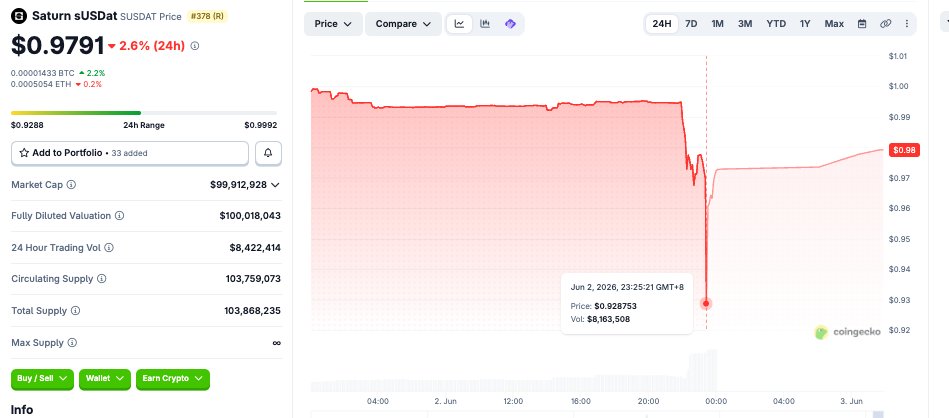
The proceeds were not used for operational expenses, debt payments, or anything that signals financial distress. Strategy sold the Bitcoin specifically to fund cash dividends on its STRC preferred stock, which is currently yielding approximately 11.5% annually. In the same period, the company also sold 801,994 shares of common stock, raising an additional $128.3 million to support distributions to shareholders.
This was not a retreat from Bitcoin. It was tactical execution, honoring commitments to STRC holders while the company continues its aggressive BTC accumulation strategy overall. The sale was executed above cost basis, planned, and proportionally microscopic. But the headline wrote itself anyway.
How sUSDat Got Caught in The Crossfire
The ripple hit Saturn Credit’s ecosystem almost immediately. sUSDat, the staked version of Saturn Credit’s USDat stablecoin, which is 100% backed by Strategy’s STRC digital credit, briefly dipped approximately 7% below $0.93 before recovering to $0.98.
🏦 sUSDat just gave us a masterclass in crypto market psychology
The staked version of Saturn Credit’s $USDat (100% backed by Strategy’s STRC digital credit) dipped ~7% below $0.93 yesterday before snapping back to $0.98. Why the volatility? Strategy disclosed its first net BTC… https://t.co/dGky7QQ2JB pic.twitter.com/Ofg19sr2o2
— Coinminutes (@coinminutes_en) June 3, 2026
For a stablecoin, that kind of intraday swing is significant, and it illustrates exactly how tightly the sUSDat ecosystem is linked to market sentiment around Strategy.
The mechanism is straightforward. When sUSDat collateral rotates into STRC for yield generation, any perceived threat to Strategy’s Bitcoin strategy creates immediate uncertainty around the underlying backing. Holders of the ethereum:0xd166337499e176bbc38a1fbd113ab144e5bd2df7 contract felt the impact directly, their staked position moved on news that, by any fundamental analysis, should not have moved anything at all.
The fast recovery to $0.98 tells its own story. Strong conviction from holders and the underlying resilience of the protocol absorbed the FUD and snapped back within hours. But the dip happened, and it was real.
Why A 0.0038% Sale Moved Markets
This is where the story stops being about numbers and starts being about psychology. Strategy’s “Never Sell” doctrine is not just a treasury policy, it is the ideological backbone of the entire corporate Bitcoin adoption narrative. Every company watching Strategy, every CFO considering Bitcoin as a balance sheet asset, every institutional investor tracking corporate BTC holdings has done so under the assumption that once Bitcoin enters Strategy’s treasury, it does not leave.
That assumption powered a story. And stories, in crypto, are priced into assets long before the fundamentals catch up. When headlines announced that Strategy had sold Bitcoin, even 32 coins, even above cost basis, even for a clearly defined and shareholder-friendly purpose, the narrative took a hit that the numbers alone never could have justified.
This cycle has made one thing consistently clear: sentiment still outweighs mathematics for a significant portion of the market. A 0.0038% sale can move sentiment more than millions in ETF flows. A single headline can reprice assets that have nothing to do with the underlying event. And a stablecoin backed by a product tied to a company that sold 32 Bitcoin can briefly lose 7% of its peg because the story shifted, even momentarily.
The Fundamentals Behind sUSDat Remain Intact
The volatility was real. The underlying case for sUSDat, however, remains unchanged. The product is 100% backed by Strategy’s STRC digital credit, and Strategy’s Bitcoin position, 843,700+ BTC and growing, is as strong as it has ever been. The company did not reverse course, did not signal a change in its accumulation strategy, and did not sell under duress. It sold a fraction of a fraction of its holdings to fulfill a dividend obligation, which is precisely the kind of disciplined treasury management that long-term investors should want to see.
sUSDat continues to offer an expected annual percentage rate of approximately 16%, delivering real Bitcoin-linked returns at a yield that reflects genuine exposure to one of the most conviction-driven balance sheets in corporate history. The dip tested holders. The recovery proved them right.
Disclosure: This is not trading or investment advice. Always do your research before buying any cryptocurrency or investing in any services.
Follow us on Twitter @nulltxnews to stay updated with the latest Crypto, NFT, AI, Cybersecurity, Distributed Computing, and Metaverse news